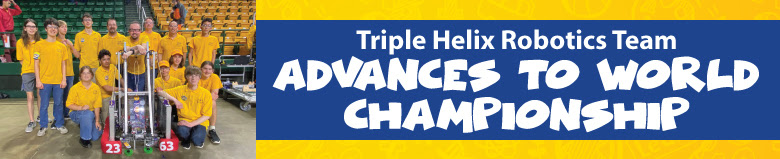
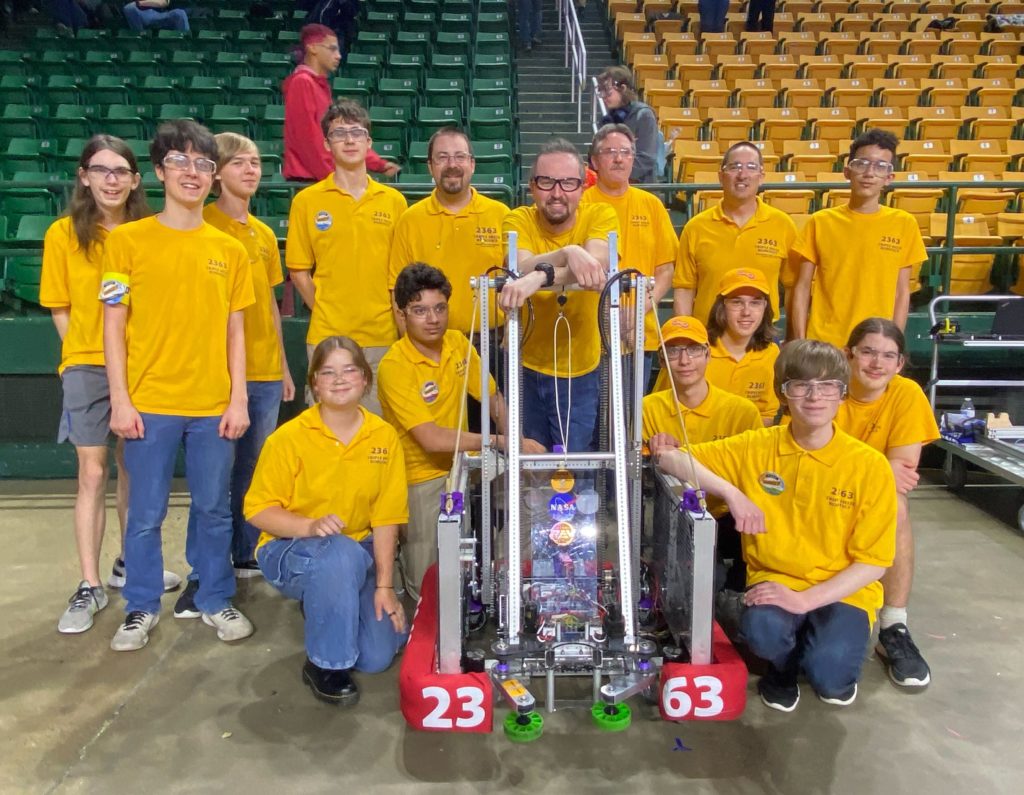
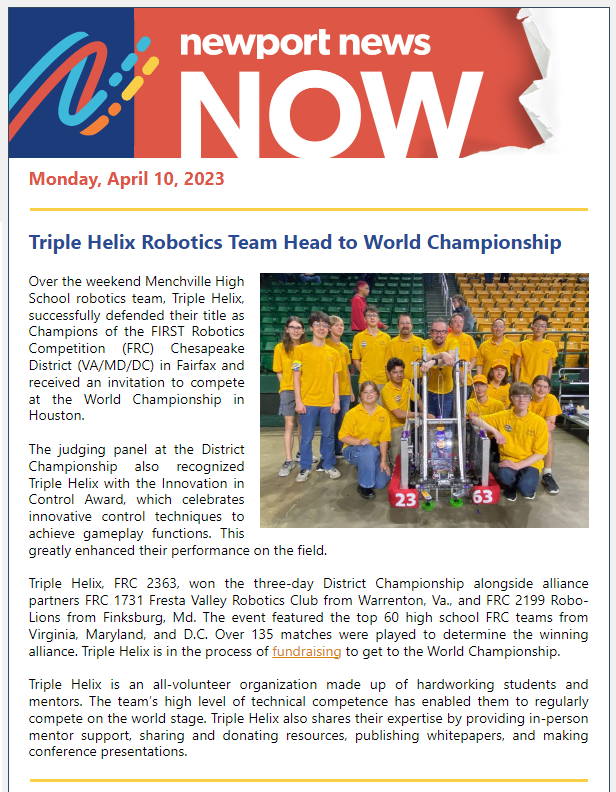
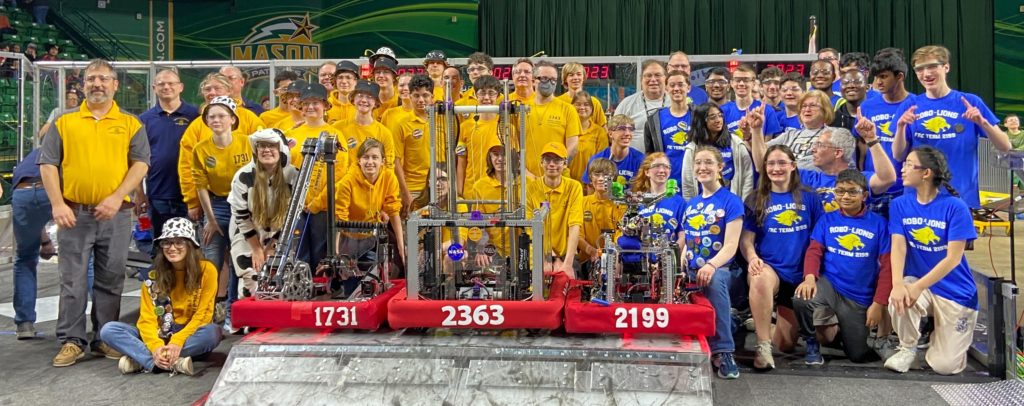
The Triple Helix robotics team, based at Menchville High School, successfully defended their title as Champions of the FIRST Robotics Competition (FRC) Chesapeake District (VA/MD/DC) in Fairfax April 6-8 and advanced to compete at the World Championship in Houston.
The judging panel at the District Championship also recognized Triple Helix with the Innovation in Control Award, which celebrates innovative control techniques to achieve gameplay functions. This greatly enhanced their performance on the field.
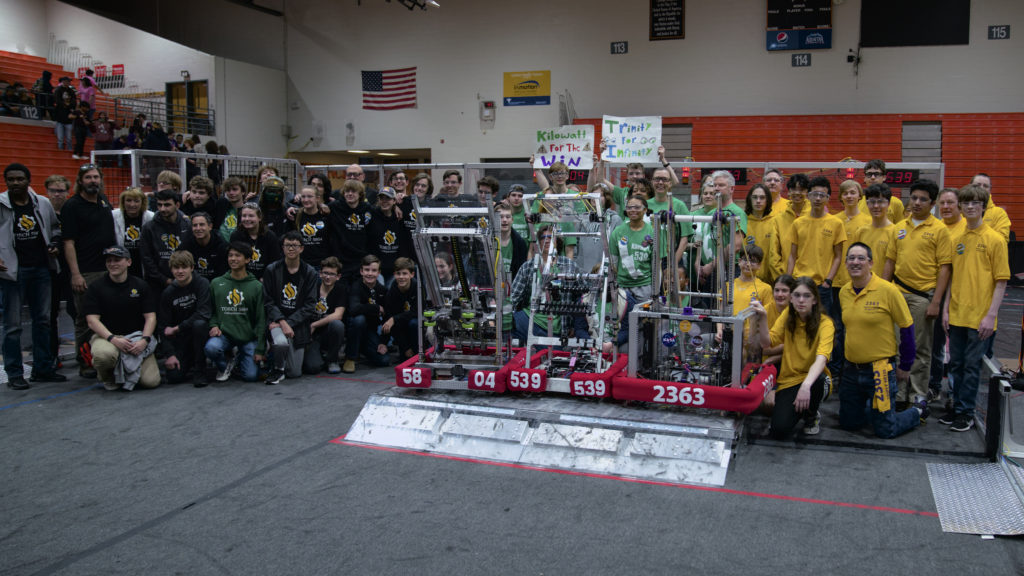
Triple Helix, FRC 2363, won the three-day District Championship alongside alliance partners FRC 1731 Fresta Valley Robotics Club from Warrenton, Virginia, and FRC 2199 Robo-Lions from Finksburg, Maryland. The event featured the top 60 high school FRC teams from Virginia, Maryland, and D.C. Over 135 matches were played to determine the winning alliance. Triple Helix is in the process of fundraising to get to the World Championship.
Triple Helix is an all-volunteer organization made up of hardworking students and mentors. The team’s high level of technical competence has enabled them to regularly compete on the world stage. Triple Helix also shares their expertise by providing in-person mentor support, sharing and donating resources, publishing whitepapers, and making conference presentations.
The chief sponsors of Triple Helix include NASA, Army Research Laboratory, DoD STEM, The Boeing Company and Newport News Shipbuilding.
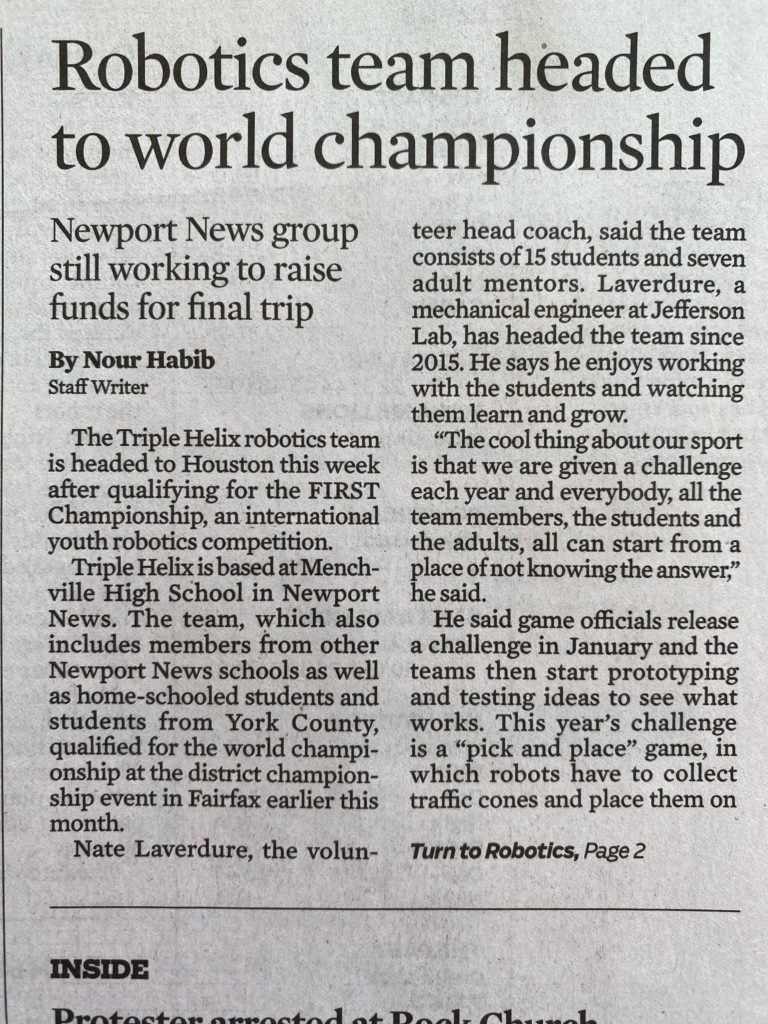
Newport News robotics team headed to world championship
By Nour Habib Daily Press Apr 16, 2023 at 10:44 am
The Triple Helix robotics team is headed to Houston next week after qualifying for the FIRST Championship, an international youth robotics competition.
Triple Helix is based at Menchville High School in Newport News. The team, which also includes members from other Newport News schools as well as homeschooled students and students from York County, qualified for the world championship at the district championship event in Fairfax earlier this month.
Nate Laverdure, the volunteer head coach, said the team consists of 15 students and seven adult mentors. Laverdure, a mechanical engineer at Jefferson Lab, has headed the team since 2015. He says he enjoys working with the students and watching them learn and grow.
“The cool thing about our sport is that we are given a challenge each year and everybody, all the team members, the students and the adults, all can start from a place of not knowing the answer,” he said.
He said game officials release a challenge in January and the teams then start prototyping and testing ideas to see what works. This year’s challenge is a “pick and place” game, in which robots have to collect traffic cones and place them on their respective “grids,” among other tasks, before time runs out. The competition involves portions of “autonomous” play, where robots operate on their own based on pre-programming by the team, as well as portions where students use a remote control to operate the robots.
Josh Nichols, 17, is the software captain of the team. He said a big part of their strategy is to simply out-practice other teams to help them be prepared for anything that can happen on the field. Nichols estimates they’ve logged more than 100 hours of practice on this challenge.
Nichols, who is homeschooled, said he’s been on the team since eighth grade. The experience has factored into his plan to pursue a career in computer engineering.
“I want to be able to try to engineer these systems that can work independently on their own, without human intervention,” he said. Think self-driving cars.
Nichols said part of the excitement about heading to the world championship is that they will get to meet and network with international teams.
“You get to interact with all these people, united by the idea of problem-solving and engineering.
Lucas Powell-Riedl is a junior at Menchville High School and has been a member of the Triple Helix robotics team since 2020. He takes care of the electrical aspects of the robot.
Powell-Riedl, 17, said he enjoys the opportunity to work with the mentors on the team.
“It sets me up with lots of connections that I can use for the future, especially since I plan on going into STEM later.”
But he also said he’s also in it for the fun.
“You get to build something yourself, design something yourself, work with teammates and friends on a project,” he said. “There’s no other thing that I’ve found, no other game, that gives you this freedom.
Laverdure said the team has qualified for the world championship several times previously, but was not always able to go to the event.
“It takes a fair bit of community support,” he said.
The team is currently raising money to help finance the trip, and anyone interested in contributing can visit www.gofundme.com/f/frc2363.
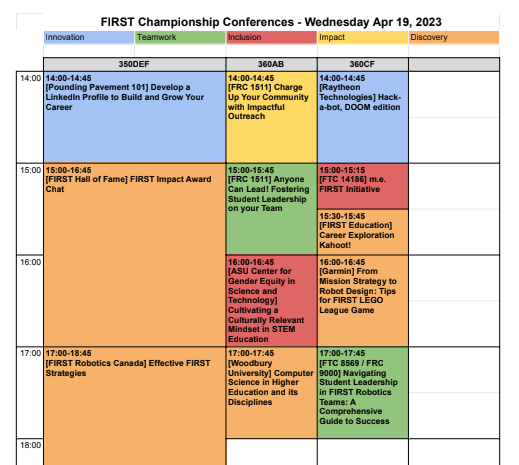
A graphical schedule for the Championship Conferences at the 2023 FIRST Championship in Houston, TX. This data was painstakingly extricated from the FIRST Championship app.
Triple Helix won the three-day District Championship event in Fairfax, Virginia, alongside our alliance partners FRC 1731 Fresta Valley Robotics Club from Warrenton, VA and FRC 2199 Robo-Lions from Finksburg, MD. The event featured the top 60 high school FRC teams from Virginia, Maryland, and DC. Over 135 matches were played to determine the winning alliance.
In our third elimination match, the 2nd-seeded 2363 – 1731 – 2199 alliance scored every available game piece and racked up an incredible 191 points, matching the world record high score for that phase of the tournament, and just shy of the maximum possible score of 193.
Triple Helix’s performance this year has qualified us to compete at the FIRST Championship, a post-season exposition of 600 high-performing teams from around the world. You can help us get to Worlds by contributing to our GoFundMe campaign at https://www.gofundme.com/f/frc2363; your support will help offset the team’s transportation costs and is greatly appreciated.
The judge panel at the District Championship also recognized Triple Helix with the Innovation in Control Award, which celebrates innovative control techniques to achieve gameplay functions. Our controls innovations are the result of an intentional, multi-year, student-driven campaign to improve our understanding of autonomous navigation and computer vision processing, and it’s through those student accomplishments that we’ve been able to capitalize on these developments to greatly enhance our competitiveness on the FRC playing field.
An enormous thank you to all who’ve made our 2023 season so successful– especially our sponsors and donors large & small as well as our mentors, families, and friends. Long-term competitiveness in this program depends so heavily on sense of community… dense networks of support… teams of teams of teams. We could not do it without you on our team. Thank you!
– Nate Laverdure Head coach, Triple Helix Robotics
LED strip lights look great on your robot, and can be used to communicate robot state to your drivers, so they never need to look away from the bot. But, the strips are vulnerable to battle damage, and the wire to strip connections are fragile. Our friends at team 1610 introduced us to these LED strip light diffusion channels that make LED strip lights on your robot way more robust. Plus, the strip light units can be made on the bench away from the robot in just minutes. Here is the process for building one of these light strip units, from start to finish.
Five teams of Hampton Roads students — and the robots they built — make playoffs during regional competition
By Gavin Stone The Virginian-Pilot Mar 20, 2023 at 6:34 pm
PORTSMOUTH — A small army of robots — built by teenagers — descended on Portsmouth this weekend to battle for supremacy.
Students from Hampton Roads were among 29 teams from the D.C.-Maryland-Virginia area who met at Churchland High School to duke it out in a game called Charged Up, which puts teams in a mock energy-storage scenario. This involves collecting cubes and cones, which are added to their respective “grids,” then balancing their robots on a charging platform before time runs out.
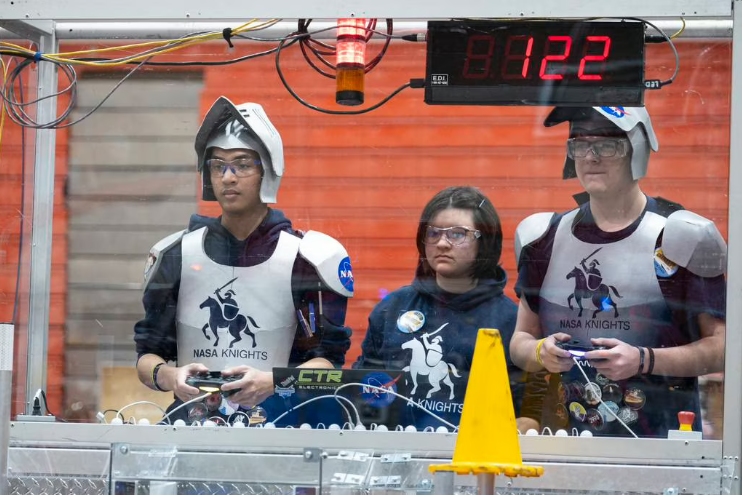
Jacob Dizon, left, and Greyson Watts, right, pilot their robot while dressed as knights in the FIRST Robotics competition at Churchland High School in Portsmouth, Virginia on March 18, 2023. The team, NASA Knights, are based in Hampton, Virginia and are sponsored by NASA Langley Research Center. (Billy Schuerman/The Virginian-Pilot)
Teams form alliances for each match and have to work together with students from other schools to win, and these partnerships benefit them in the playoffs when the top-performing teams get to pick who will join them. Students also take on the role of talent scouts, evaluating what their robots’ weaknesses are and identifying teams that can offset them for the best chance of winning.
This spirit of “coopertition” — a mashup of the words cooperation and competition — extends to the sharing of parts to help with repairs for damage sustained during matches, according to David Martin, a mentor for Royal Robotics of Portsmouth.
Of the seven Hampton Roads teams competing this weekend, five made the playoffs, with Triple Helix Robotics out of Menchville High School in Newport News leading the winning alliance in the final round. The teams that qualify for the district championship at George Mason University in April won’t be selected until after the next Charged Up event in Glenn Allen this weekend. All these events lead up to the world championship in Houston the weekend of April 19.
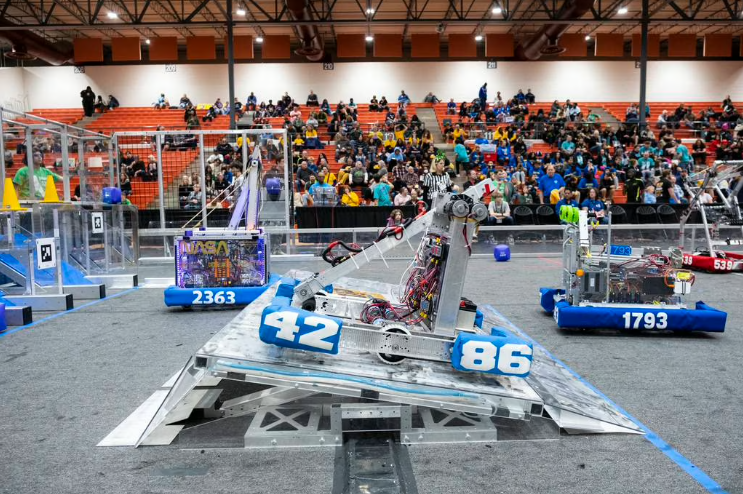
The robot from team Imperial Robotics (4286) attempts to balance on the charging station before time expires, while Triple Helix’s robot (back left) works on adding the cubes and cones to their grid, at the FIRST Robotics competition at Churchland High School in Portsmouth on March 18, 2023. (Billy Schuerman/The Virginian-Pilot)
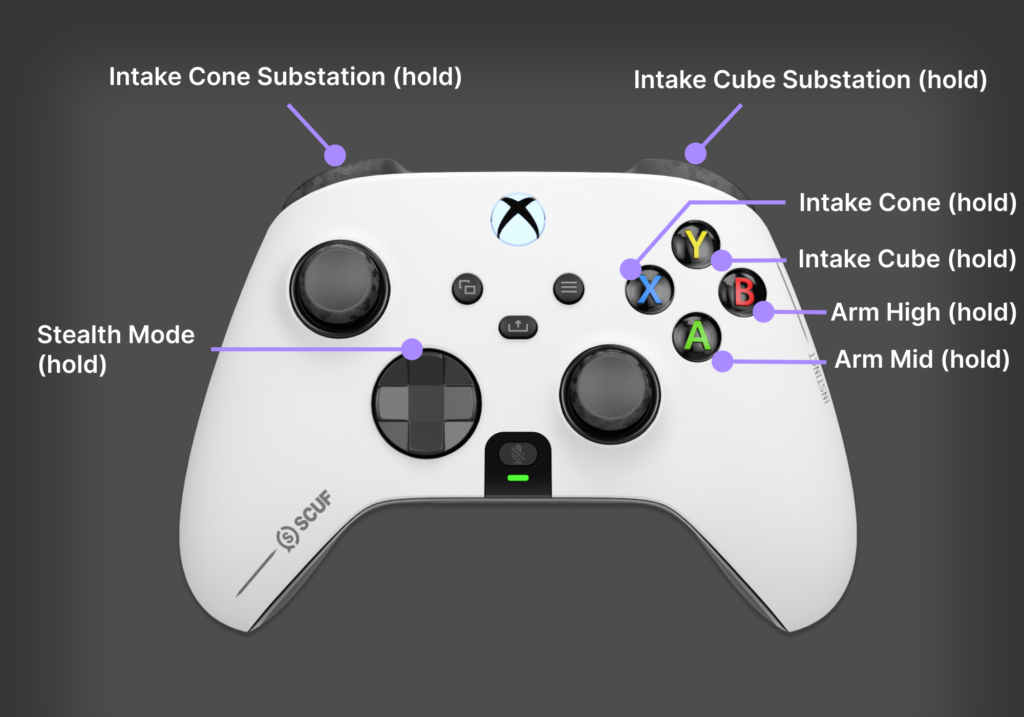
Each match starts with the robots operating autonomously for 15 seconds to try and score points. Then the students take over — often with a familiar Xbox controller — as chaos ensues. The robots frantically zoom around the playing field and smash into each other over and over while precisely guiding the cones and cubes into their grids.
The students have access to base code and guidelines for certain parts of their robots, but the majority of the construction is the work of the students themselves, Martin said. The students also determine their strategy.
The autonomous portion is where Triple Helix Robotics, which counts NASA among its sponsors, felt it could get out ahead of the competition early. The team’s autonomous performance ultimately won it the Autonomous Award given to the robot with the best ability to sense its surroundings, position itself and execute tasks on its own.
Triple Helix members honed their code at the STEM Gym in Newport News, where they can scrimmage other teams on a replica playing field similar to the one used this weekend, according to head coach Nate Laverdure. He explained that their robot was able to read the barcodes on the grids and use those to triangulate its location, count the rotations of the wheels and calculate its inertia — and use all these data points to guide the robot where it needs to go as accurately as possible.
“These kids are doing stuff that academic researchers are writing their Ph.D. theses on and people in industry are building companies around — there’s companies that are focused on solving exactly the same problems that we’re solving with high school students,” Laverdure said.
Jonathan Buszard, a junior in Triple Helix, said that engineering classwork can only take you so far.
“This is like you’re right in the thick of it, doing all the stuff you’re learning, doing new stuff all the time,” Buszard said.
Another NASA-sponsored team from Hampton Roads, the NASA Knights — a team out of New Horizons Regional Education Center in Hampton who were decked out in makeshift suits of armor — said they spent about 14 hours per week on their robot. Freshman Grace Walker said she put in a total of about 300 hours in their shop last year during the season and offseason.
“It was pretty much my second home,” Walker said. “I was like, ‘Oh I’m back here again, might as well build a robot.’”
Royal Robotics out of Churchland High School improved on its performance at the previous competition, during which it broke its robot’s claw almost immediately. This time it employed a simpler grabbing mechanism using a pneumatic system that simply squeezed two metal bars together, and worked out some new code for the autonomous portion that paid dividends on Sunday.
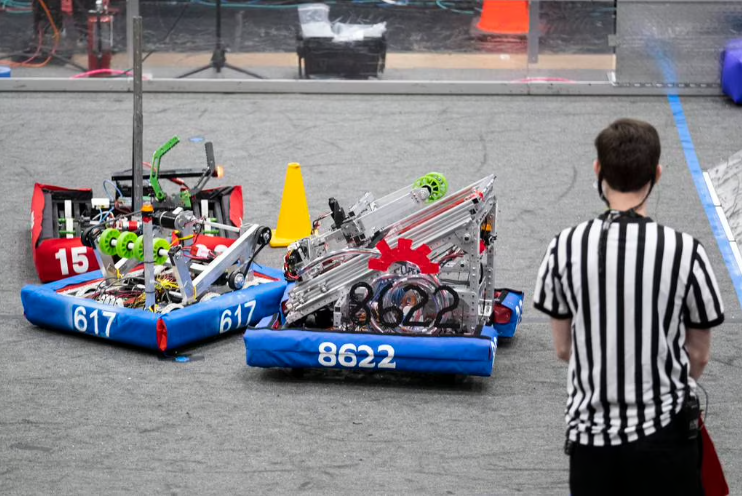
Robots battle for rank at the FIRST Robotics competition at Churchland High School in Portsmouth on March 18, 2023. (Billy Schuerman/The Virginian-Pilot)
Going into the weekend Royal Robotics wanted to have all three of its alliance’s robots balanced on the charge station, which is worth a lot of points because of the coordination it requires, but one of its allies’ robots knocked another ally’s robot off the charge station in the process, explained Ray Clause, a senior at Churchland High School and build captain. Clause said he tends to focus on gathering the cubes and stealing them from the other alliance when he can, “because that’s just the kind of person I am.”
Not only are students applying what they’ve learned in school and putting those concepts into action, they’re also learning complex social skills that will serve them later in life, Martin explained.
“It’s been very rewarding seeing the kids grow and just being able to learn stuff, some kids come in pretty shy, and getting them to open up — it’s been good,” Martin said. “We’ve had kids that come in who weren’t very social and by the end they’re still not super social but they at least do get more social, and that’s good to see.”
Chris Wilson, a sophomore at Churchland and the programmer for Royal Robotics, said he was completely uninitiated in basic physics concepts, but now he’s got a working knowledge of them.
“Two years ago when I first joined, when they were mentioning things like torque and force and centers of gravity — I didn’t know a thing,” Wilson said, “but now I’m like, ‘OK, I understand what stuff is and how it works.’”
This weekend in Portsmouth, Triple Helix Robotics steamed to another victory on the FRC playing field, captaining our alliance of three teams to bring home our 6th win in a row in official play. The team is now ranked #1 in Virginia, #1 in the Chesapeake District, #14 in the US, and #17 worldwide.
Triple Helix won the event alongside two alliance partners from Richmond: 5804 TORCH from the Collegiate School and, 539 Titan Robotics from Trinity Episcopal School.
The judges at the event also recognized Triple Helix with the Autonomous Award– our second such honor this season! Owed greatly to our high performance in the autonomous mode, our win-loss-tie record now stands at 31-5-0 for the season.
The team greatly appreciated the strong support of our parents and friends at this event– thanks to all the visitors who stopped by and wished us luck! We definitely needed it, as this event was by no means a cake walk. In addition to the exciting competition from several strong opponents, we struggled with a strange low-level software issue that sometimes caused our robot’s processor to reboot mid-match. This issue even appeared in our finals matchup against the powerful #2 seed alliance captained by 3136 ORCA and featuring the heavy-hitting cone scorer 1599 Circuitree.
The team will be working on stomping this bug– as well as continuing to reap the benefits of extensive practice with our robot at the Peninsula STEM Gym operated by Intentional Innovation Foundation– as we prepare for the FIRST Chesapeake District Championship on April 5-8 in Fairfax, VA.
– Nate Laverdure Head coach, Triple Helix Robotics